While new publications are always a thrill, I was especially delighted to find that Through the Looking-Glass: A Companion was featured by our publishers to explore what makes a successful book launch for future authors, through our two launch events.
They highlighted our unique settings – the birth places of Lewis Carroll’s famous novel, as well as that of Disney’s (and Burton’s!) almost equally famous movies, our engaging programming – our Spectral Science exhibition, and an authentic Victorian Phantasmagoria in Los Angeles, and an exclusive Special Collections Display at Christ Church, Oxford, as well as strong author presence, through expert panels and reflections at both Christ Church and in Los Angeles.
You can read more here – and order our book for your students & library here.
Delighted that our publishers selected "Through the Looking-Glass: A Companion" to reflect on what makes a successful book launch (or two!)🪞📚Unique setting (birth places of Carroll's book & Disney's movie)📚Engaging Programming📚Strong author presenceRead more:www.peterlang.com/article/the-…
A VERY LABC HALLOWEEN! Put on your favorite costume and come celebrate Halloween with the LA Breakfast Club! Magic Lanternist Melissa Ferrari and historian Dr. Franziska Kohlt will transform Friendship Auditorium into an immersive horror theater full of fantastical and dreamlike imagery.
ABOUT THE PRESENTATION & MAGIC LANTERN PERFORMANCE: On a rainy 19th-century evening, the public flocked to the Royal Polytechnic Institution of London to partake in the technological spectacle of a new Magic Lantern show. That evening, they were treated to a performance of bestselling children’s fantasy Alice’s Adventures in Wonderland, whose author, Lewis Carroll, had long been an aficionado of Phantasmagorias, magic lanterns, microscopes, telescopes, and every optical spectacle the Victorian age had popularized to shape a culture. These devices not only had a profound influence on the creation of one of the most popular children’s books of all time, but also on early cinema.
Historian of science Dr. Franziska Kohlt and magic lanternist Melissa Ferrari bring you a presentation and live Magic Lantern performance exploring the intersections of science, illusion, and the supernatural. Dr. Kohlt, inaugural Carrollian Fellow at USC, will share her research exploring how literary minds such as Lewis Carroll viewed new technologies and scientific discoveries of the late 19th and early 20th centuries as a means of accessing “other worlds” beyond human perception. The presentation will feature a revival of the 18th-century tradition of Phantasmagoria, a form of immersive horror theater where hidden projectors conjured apparitions and supernatural creatures, with a Carrollian twist. Performed with authentic 19th-century Magic Lanterns and Ferrari’s handmade & antique slides, the show will feature a preview of their new collaboration Phantasmagoria: Lighting the World Beyond, premiering later that evening at the USC Doheny Library, and take you from rainy nineteenth-century London, via the mysterious sides of California, to realms unknown.
Beyond thrilled to announce that “Alice Through the Looking-Glass” is published today!🪞In 516 pages, 38 essays by 42 authors, this book offers a truly interdisciplinary exploration of the polymathic influences that shaped Through the Looking-Glass, the lesser explored sequel of Alice’s Adventures in Wonderland, covering the history of science, logic, philosophy, theology, literature, popular and visual culture, and translation, business, data science, writing, and the visual arts. And all that for only £28 – get it here.
We are thrilled to extend an invitation to celebrate the publication of the book at Christ Church, Oxford’s Upper Library, where Lewis Carroll was once himself sub-librarian, on Friday the 27th of September – tickets are free, but booking is essential. There will be talks by contributors Prof Adam Roberts, Rev Dr Karen Gardiner, Catherine Richards, Dr Nick Coates and myself, a panel discussion, special collections display and wine reception.
I am especially grateful for the generous endorsements of Brian Sibley, BBC veteran and Chair of the Lewis Carroll Society, and Prof Kiera Vaclavik, Professor of Children’s Literature & Culture – «This volume is colossal in all senses: most obviously – at over 500 pages – in its sheer physical heft, but most importantly in its ambition, scope and achievement. It brings an unparalleled range of approaches to bear on Carroll’s neglected sequel and in doing so marks the arrival of an exciting new wave of Carrollian scholarship and enquiry. A comprehensive and illuminating companion to Looking-Glass and its author, it is also an exemplar of everything that collaborative, transdisciplinary scholarship can offer.» – Kiera Vaclavik, Professor of Children’s Literature and Childhood Culture, Queen Mary University of London
«This impeccably edited volume with its impressive assemblage of contributors addresses a diverse array of topics: the creation, illustration, translation and commercialization of the world beyond the mirror; discussions philosophical, psychological and theological; studies on logic and linguistics; and, fittingly for a nonsense classic, speculative examinations of the flora and fauna of the Looking-Glass World. This stimulating collection of essays is a timely appreciation of a literary masterwork too long overshadowed by its elder Wonderland sibling.» – Brian Sibley, Chair of The Lewis Carroll Society
Today I took a copy of this book to its new home in the Library of @ChCh_Oxford where Lewis Carroll was once sub-librarian. Feels like a full circle moment.
Pictured: the book on the windowsill of Carroll's old office, w Cheshire cat tree.
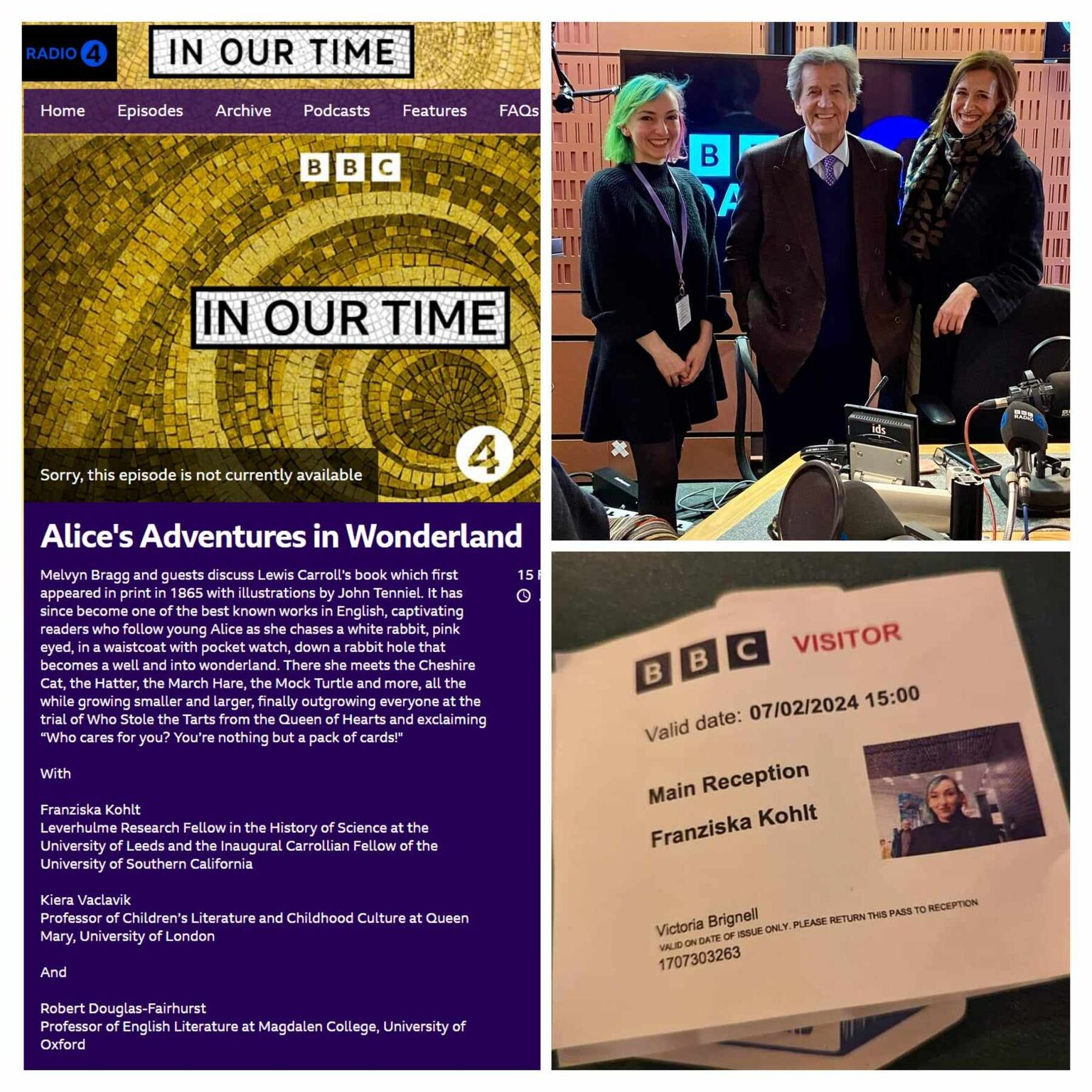
Great pleasure being back at BBC Broadcasting House with Melvyn Bragg for BBC Radio 4 In Our Time, to explore all things “Alice in Wonderland” with Professors Kiera Vaclavik and Robert Douglas-Fairhurst. The programme will air on Thursday 15 February, 9am & 9:15pm GMT; it’ll be available as a podcast afterwards (with extra content!). If you can’t wait, you can listen to last time I was on IOT, speaking about automata, here.
If you’ve always been curious what Lewis Carroll’s Alice has to do with Science, Medicine and the Environment, this Saturday you’ll have a unique opportunity to find out in my online lecture for the Lewis Carroll Society of North America, where you’ll be able to get an exclusive preview for my two (!) forthcoming books on Alice, and my latest research in this field. The talk will be online, free, and, recorded, in case you can’t make it – and it’s this Saturday, 12th of August, 7pm British Summer Time, 2pm EDT & 11am Pacific Time. Zoom link & more info here.
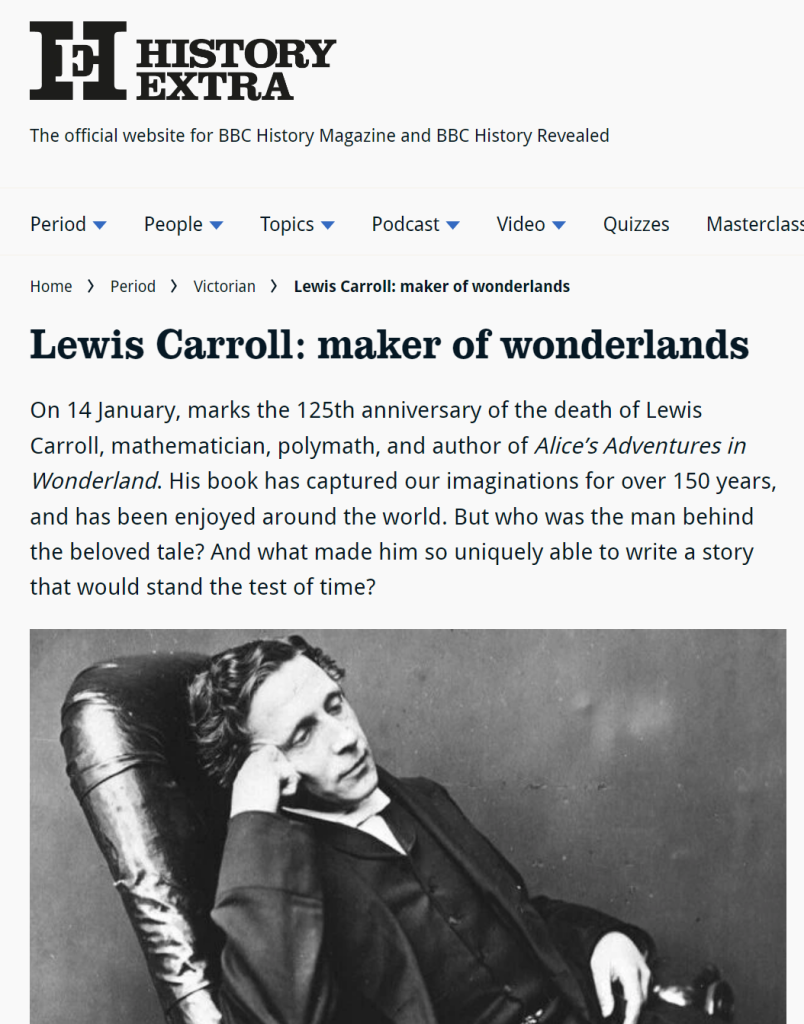
To honour the 125th anniversary of Lewis Carroll’s death, BBC History asked me to write an article about the man, his life – and of course his most famous work: Alice’s Adventures in Wonderland.
It’s unusual to have 2000+ words to explore a topic in a little more depth – so I hope you enjoy this portrait of the “maker of Wonderland” which is out today.
As for one of my favourite parts of the story, though, scroll on…
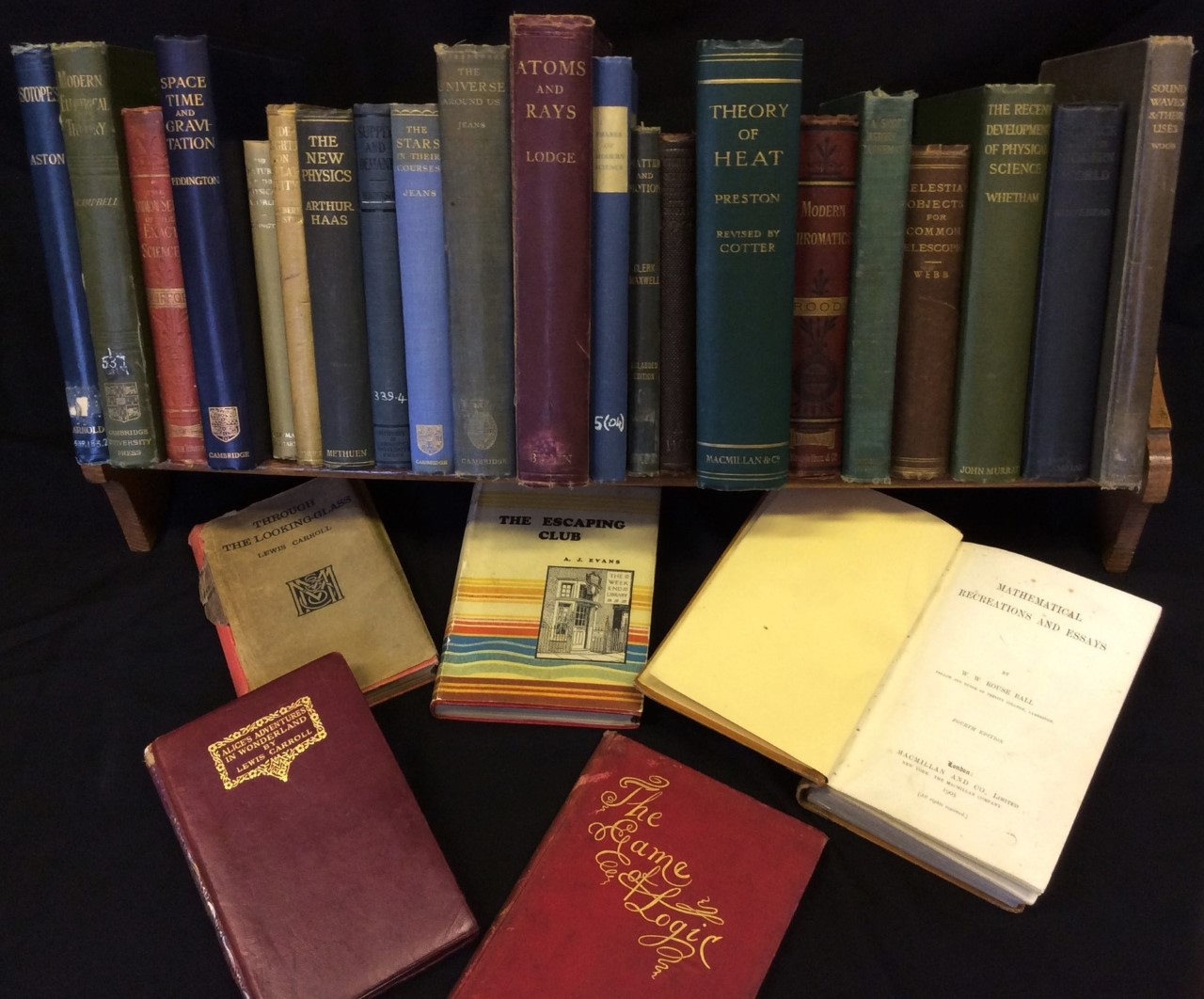
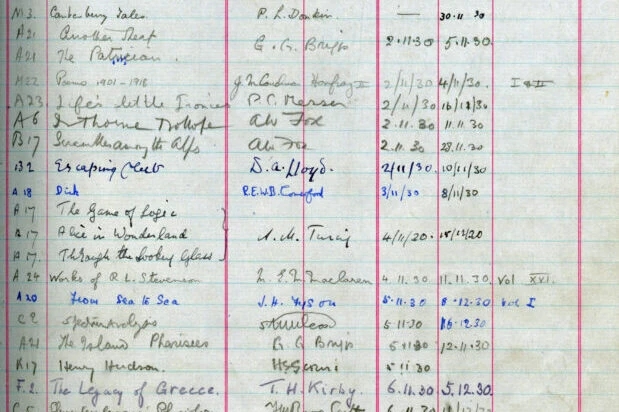
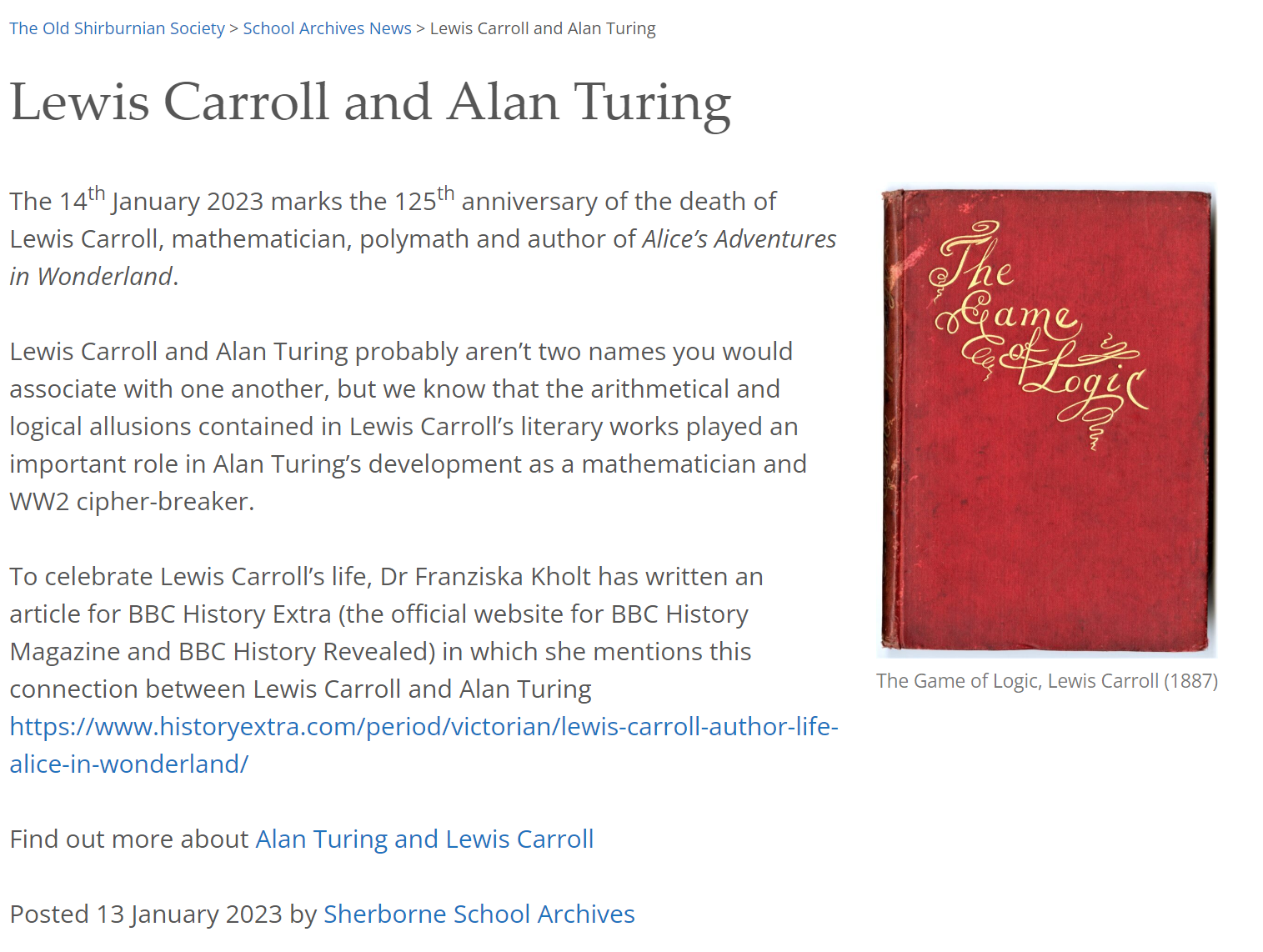
One of my favourite parts of this story comes right at the end. Among the people who admired Carroll and was inspired by his work – his mathematics as well as his fiction, was the young Alan Turing, who borrowed from his school library at Sherborne both Alice books – Wonderland and Through the Looking-Glass – and The Game of Logic (pictures are courtesy of Sherborne School archives).
Sherborne School also feature the anniversary, as well as the Turing connection in a post on their website, as well as in their letter to current students and alumni.
If you haven’t had enough of last year’s Through the Looking-Glass bicentenary, I’m speaking on this forthcoming BBC “The Forum” episode on the Cultural History of Mirrors. I’m part of a panel including Elizabeth Baquedano and Mark Pendergrast, and discuss mirrors in the history of science, theology and literature. The programme will be aired on 21 April 2022, and will subsequently become available online here.
This is what the BBC website says:
“For the Ancient Egyptians they were seen as receptacles for the soul, for the Aztecs they were used to tell the future and for the early Christians, they were an aid for reaching self-knowledge. And mirrors’ key role in the reflection of light led to the development of high-powered telescopes to explore the universe. No human invention has been so closely tied with our sense of self and the world around us. And yet mirrors also have a capacity to deceive us – so how much attention should we give them in our lives, and are we overly obsessed with our image in the mirror?”
And in today's adventures I'm recording an episode of 'The Forum' for @bbcworldservice on mirrors in #histsci, religion, literature& art!
To think that a decade ago I learned English by listening to the World Service on my way to work, hoping to study English at uni #fullcirclepic.twitter.com/fxkO8ETRwF
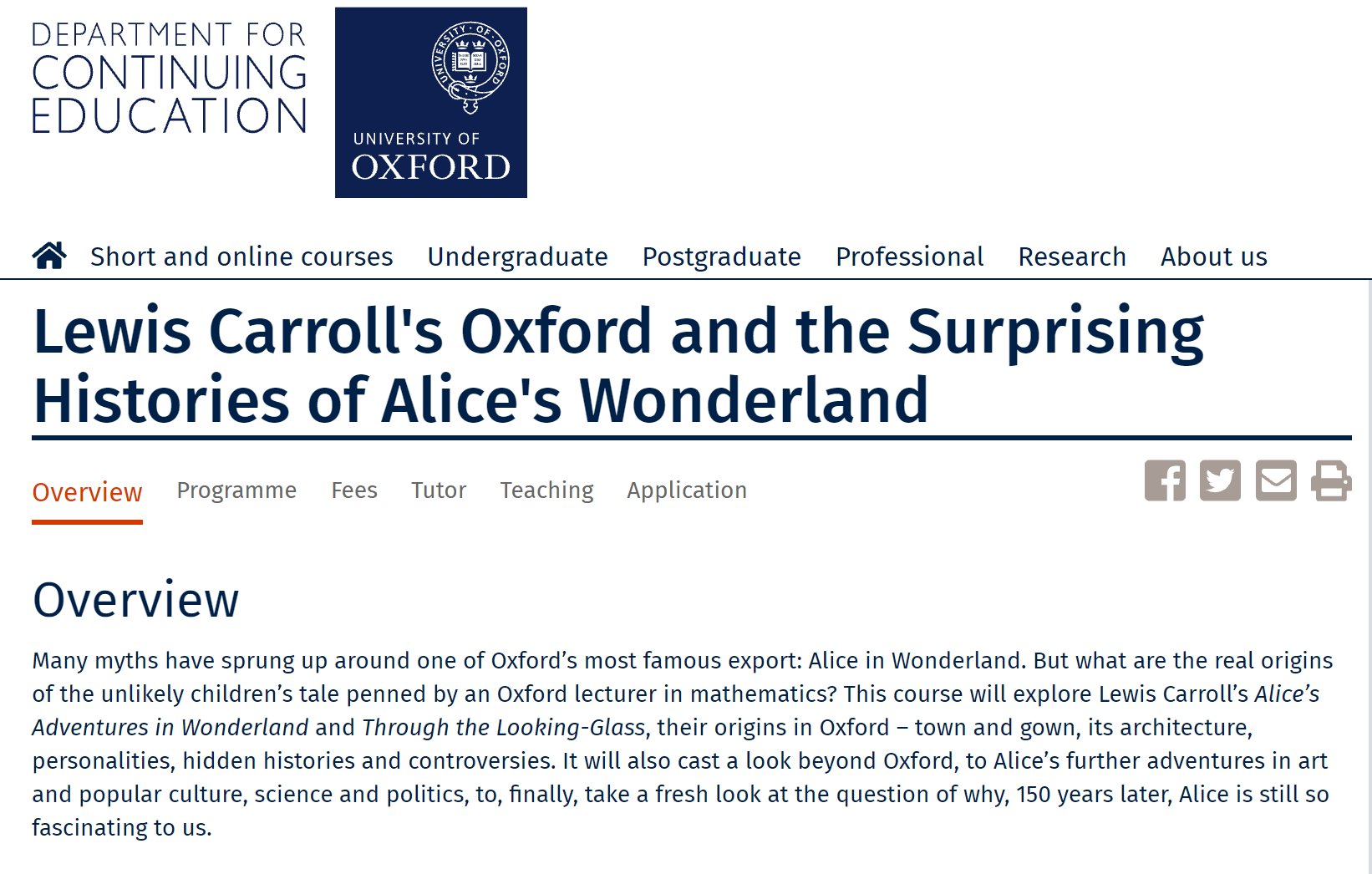
From June 2022, I am taking on leading this fantastic programme at the University of Oxford’s Continuing Education Department (you can peruse the course contents here). The course will offer a fresh, thought-provoking take on the place of Lewis Carroll & his most famous books in their time, and their continuing appeal in ours. It will explore the role of Oxford in its creation, but also how looking at the Victorian contexts that inspired it – from science and medicine to music and logic – but also how that can help us navigate intellectual and social challenges of the past, but, hopefully, also illuminate our own – and teach us how to think, learn, talk and write about them.
This is a bit exciting, but it's official: From 2022 I'll be taking over the course 'Lewis Carroll's Oxford & the Surprising Histories of Alice's Wonderland' at @UniofOxford's @ContEdResearch! V excited to be returning to Oxford for this next summer!🐰🕳️https://t.co/G5dravL5ur
A lovely feature about Lewis Carroll & his Yorkshire connections appeared in the Yorkshire Post yesterday – for which I was interviewed. They give a shout-out to our Looking-Glass Sesquicentenary conference also (registration is now open btw! Have a look at our programme too!)
You can find the article on the Yorkshire Post website (sadly paywalled) or you can have a cheeky look at my Instagram for pictures of the print article.
Oxford is well-known to have inspired Alice’s Adventures in Wonderland (1865), but the extensive influence of the Oxfordshire countryside on Through The Looking-Glass (1871) is less frequently discussed. My talk will therefore not only uncover some of these inspirations, from Oxford’s architecture to Oxfordshire’s agricultural history, but also illuminate how Lewis Carroll’s wider interest in nature, science and industry – and thus also the railways – shaped Through the Looking-Glass, and explore how this can help us approach and rethink contemporary challenges posed to the balance between nature and the necessities of modern life. (Announcements for the talk have appeared also here and here)




 Dr Franziska Kohlt