
Looking forward to this wonderful occasion to share my work on the intersection of entomology, storytelling and history, and what Science Communication can learn from it today (always thrilled to bang the drum for science x humanities x social science!)
Tag Archives: Insects
University feature on Importance of Humanities in Environmental Conservation
I’m so honoured to see my work on Storytelling & Narratives on the perception of Insects featured by the University of Leeds today. I’ve been so grateful to my colleagues for the collaborations, and the Royal Entomological Society for supporting and making visible this important work for so long – it’s great to see a shift in the public discussion of science towards the importance of traditionally humanities-based research. If this interests you, check out this radio programme on Moths, or this article on insects in games, films and books.
An extract from the blog highlights:
We may not always realise it, but our attitudes, likes and dislikes, fears and habits are often crafted for us by generations of narratives. For example, many people understand the benefits of a healthy bee population. They may see bees as cute, helpful and unique. However, they might hate wasps with a passion, find them to be a nuisance and want to avoid “wasp season” at all costs. In truth, both are pollinators who improve our natural world, even if they also have the potential to sting us. Dr Franziska E Kohlt researches how narratives shape our relationships with insects. From Alice in Wonderland to Animal Crossing, we have all absorbed stories about animals throughout our lives.
Filed under Update
Perceptions of Insects: Panel Discussion for Royal Entomological Society’s Insect Week
Love insects? Hate Insects? Bees good, wasps bad? Butterflies wow, moths yuk?
How do we come to love and hate insects, or prefer some insects over others? And why is this a crucial question in times of climate and biodiversity crisis, and what can we learn from it?
I was thrilled to join a panel discussion on this topic for the Royal Entomological Society’s National Insect Week with Prof Adam Hart, Prof Seirian Sumner, Prof Verity Jones, and Liam Hathaway
You can watch the recording here, and also read a shorter blog summary here!
Filed under Uncategorized
CFP: Insects in the Popular Imagination of the 21st Century [updated]
Simon Bacon and myself are excited to circulate a CFP for a collection with the preliminary title ‘Insects in the Public Imagination of the 21st Century’.
The planets last hope, messengers from Hell, environmental revenge or the post-human future insects are vital to our continued existence on the Earth yet trigger all manner of anxieties around the precarious nature and integrity of our psychological and physical selves. This collection looks at the place of insects in the popular imagination, across cultures and mediums in the 21st Century and what it might say about our relationship to the natural world and possible post/non- human futures.
At this stage just send a notice of interest or a 300 word abstract if you’ve got something ready by the end of March 2022, final essay wouldn’t be needed til 2024.
Message or mail us on: baconetti@googlemail.com & franziska.kohlt@york.ac.uk
Filed under Uncategorized
Railways, biodiversity, agricultural history and…Through the Looking-Glass?
On the 25th of November I will be giving a talk at the Abingdon Arms, Beckley, just outside Oxford.
The occasion is not only that the award-winning Pub overlooks Otmoor, the nature reserve which some believe may have inspired Lewis Carroll’s chessboard landscape in Through the Looking-Glass (I will investigate this claim), but also the planned resurrection of the Oxford-Cambridge Expressway through this area of scientific interest, which is noted especially for its biodiversity by the RSPB.


Oxford is well-known to have inspired Alice’s Adventures in Wonderland (1865), but the extensive influence of the Oxfordshire countryside on Through The Looking-Glass (1871) is less frequently discussed. My talk will therefore not only uncover some of these inspirations, from Oxford’s architecture to Oxfordshire’s agricultural history, but also illuminate how Lewis Carroll’s wider interest in nature, science and industry – and thus also the railways – shaped Through the Looking-Glass, and explore how this can help us approach and rethink contemporary challenges posed to the balance between nature and the necessities of modern life. (Announcements for the talk have appeared also here and here)

The Looking-Glass countryside, John Tenniel
Filed under Uncategorized
Insects Through the Looking Glass
With Alice’s Day gone, ‘Insects Through the Looking Glass’ has now finished at the Story Museum – and we’ve had a fantastic time! We’ve met so many excited visitors, it’s been a really exhilarating experience. We owe our thanks, first of all to our hosts at The Story Museum, and our funders at the Royal Entomological Society and the British Society for the History of Science, but especially also all those who helped us make the event such a success – the Oxford University Museum of Natural History, Beetle Boy author M.G. Leonard, illustrator Carim Nahaboo, and Tolkien expert Dr Dimitra Fimi!
For all those who haven’t been able to go – here are some thoughts and reflections on our exhibition – but we will also be travelling on, so watch this space…!
#scicomm at the Story Museum
As I explained to the Oxford Times, however you feel about insects, they have always fascinated us humans. Egyptians worshipped them as Gods, they inspired the most famous scientists in history, and they are characters in some of our favourite stories – they become deeply woven into our culture. But we also depend on insects for a healthy environment and our own survival. They pollinate our crops, remove waste from the environment, and create healthy soils. But recent headlines tell us about the sharp decline in bee populations, and entomologists warn us that if insects disappear, so do the vital services they provide us and our environment, putting us all in danger.
Despite their importance, insects are more often portrayed as objects of terror and spreaders of disease. However a quieter revolution has been happening for over 150 years in the stories we read to our children, in which insects have slowly conquered the role of heroes to challenge these negative attitudes. ‘Insects Through the Looking-Glass’ explores how ‘the little things that run the world’ inspired such famous children’s writers as Lewis Carroll, Roald Dahl, and M.G Leonard – award-winning author of the Beetle Boy trilogy.
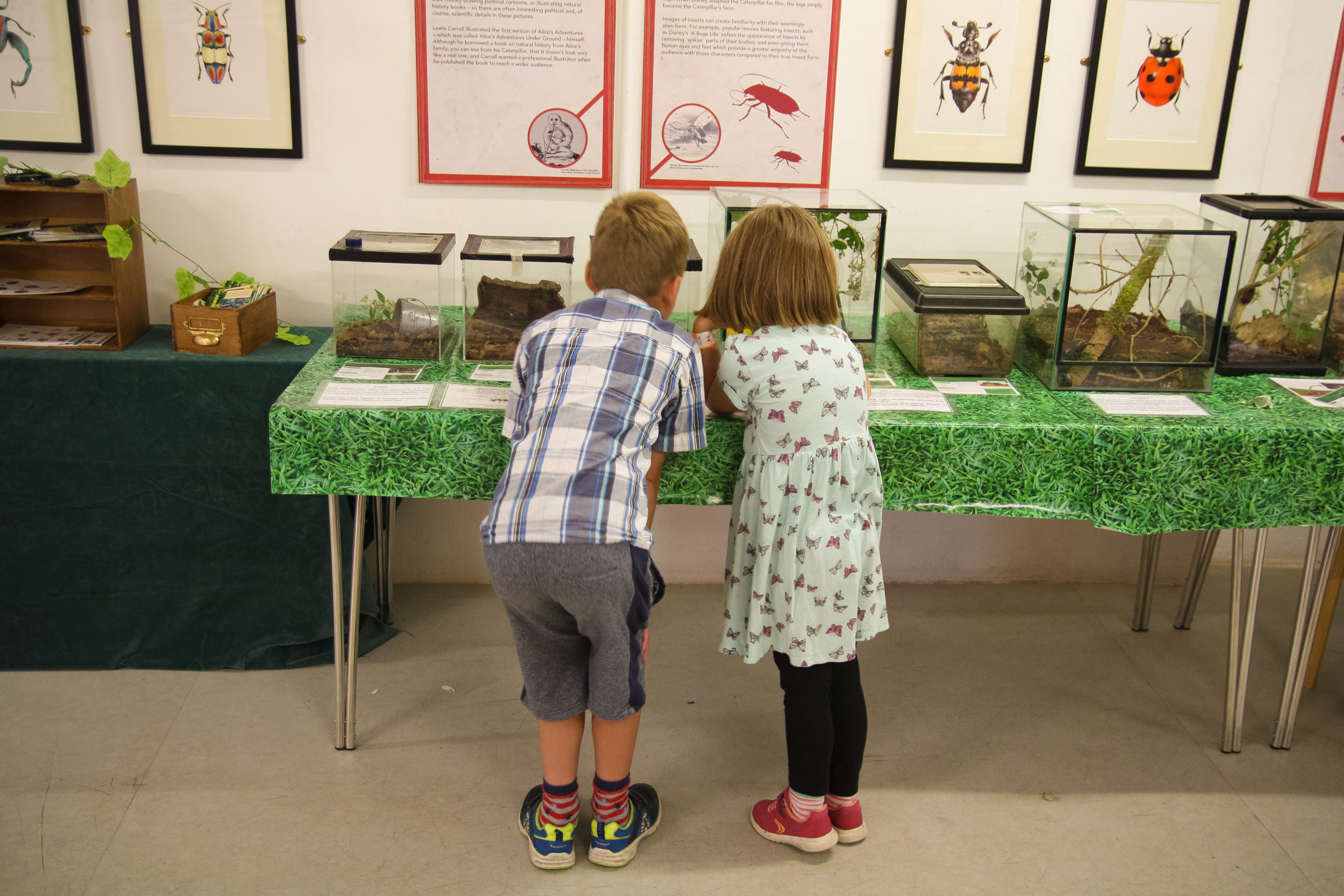
With funding from The Royal Entomological Society we were excited to be part of their National Insect Week, and, hosted by Oxford’s Story Museum, the exhibition ran through to their Alice’s Day. Real insects (living ones from The Travelling Insectarium, and historical ones from the Oxford Natural History Museum’s collections), giant insect illustrations, historical entomology books, author readings, an illustration workshop and expert talks brought to life a literary journey from the Victorians age of discovery, to the environmental revolution of the twentieth century to the information revolution of today — to explore how the unique perspective of children’s literature has always led the way in shaping, and challenging how we perceive nature around us, and engage with it.
Entomology in literature – and history!
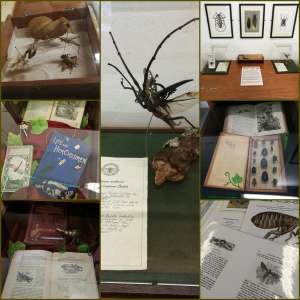
One of the centrepieces of our exhibition was the “Entomologist’s Desk” – a real collaborative effort. This exhibit was funded by the BSHS Outreach and Education Committee with the aim to engage with the historical side of our exhibition — click on the Instagram link below through the photos below for a ‘making-of’!
We wanted to show what actual entomological science inspired the authors’ thought, with magnifying glasses, pencils and paper provided, visitors themselves became the explorers of entomological history. On top of the desk we displayed reproductions of specimens collected by Charles Darwin and Alfred Russel Wallace on their journeys upon which they devised their theories of evolution by natural selection. Some drawers contained displays of Victorian children’s science books which we know Lewis Carroll suggested, which were displayed alongside actual specimens from the museum at which we know he worked photographing their inventory (things you never expected to learn as a humanities scholar: pinning insects!). For a chance to handle these often fragile historical books other drawers contained laminated reproductions of the books displayed, but also Victorian science-fairytales, such as Charles Kingsley’s Water-Babies (1862-3), a story about actual and metaphorical metamorphosis in the natural world and in more philosophical ways, or Margaret Gatty’s Parables from Nature (1855), which contained a story about a indignant Caterpillar not quite dissimilar from Carroll’s in Alice’s Adventures in Wonderland (1865). With this we wanted to show how historical environment influenced writers, and how such details, as for instance Carroll’s Caterpillar, actually already had currency in a literary, scientific and philosophical context – in the case of the Caterpillar as a vehicle for exploring the meanings of metamorphosis and transformation in nature, evolution, and, in the case of children’s literature, child development, in an educational and psychological sense. This traced the process of where scientific exploration blends into scientific, and eventually literary imagination, as in our drawers imaginary bread-and-butter-flies and rocking-horse flies happily intermingled with the real, but similarly portmanteau tiger-moths, crane-flies and mole-crickets of ‘real’ science.
Literature meets Science


As we were located in the Story Museum, we really wanted to illuminate the creative process of our authors through the lens of their preoccupation with entomology.
We arranged an author reading by M.G Leonard, who also recounted how she overcame her fear of insects when she started researching them for her books and discovering what these little creatures were capable of – and it “blew her mind”. She explained also why her books have a clear mission. “We think the world is ours, but the micro world is surprising in ways we don’t even begin to understand”, she said, and warned: “We need to get our children appreciating and understanding the needs of all manner of wildlife. It is more important now than ever that we form a relationship and attitude to the natural world, or we risk losing it.”
Two talks about authors (who, unfortunately, can no longer speak for themselves) focused on the entomological interests of J.R.R. Tolkien and Lewis Carroll. Aimed at different audiences, the talk on Tolkien as one a stand-alone event attracted a wide variety of members of the public, from Middle Earth Enthusiasts to Tolkien scholars who joined us from the major Tolkien exhibition at the Bodleian Library. Dimitra Fimi spoke illuminatingly about insects being firm part of Tolkien’s world-building, he even had words for several species in his various imagined languages. A real highlight of the talk (that is, beside Dimitra singing one of Tolkien’s songs!) were Carim Nahaboo‘s amazing especially-commissioned illustrations of Tolkien’s insects which showed the detail of how species adapt to their environment (the Mordor-flies will haunt you in your dreams).
As part of Alice’s Day, a free, annual family event that attracts diverse audiences, we also welcomed some younger audiences, who now all know where Disney went wrong (anatomically) in their portrayal of the Caterpillar. As the curators, Chris Jeffs and I split our talk between the literary and historical, and the scientific side of ‘Insects in Wonderland’, and while I explained literary attractions of the idea of metamorphosis, and Chris showed why it is such a successful concept in evolutionary terms.
Where to next?
At our panel at this year’s British Society for Literature and Science Conference we announced our outreach survey which we will shortly re-launch, and we are hoping to further share our insights into coordinating cross-disciplinary public engagement in more organised form. I will shortly be writing a blog on this topic for the British Society for History of Science, so please be in touch – we would like to take into account as much feedback as possible! As to further destinations of our exhibition, stay tuned, and if you’d like us to travel your way, please get in touch!
Curiouser and curiouser…
Filed under Uncategorized


 Dr Franziska Kohlt