While new publications are always a thrill, I was especially delighted to find that Through the Looking-Glass: A Companion was featured by our publishers to explore what makes a successful book launch for future authors, through our two launch events.
They highlighted our unique settings – the birth places of Lewis Carroll’s famous novel, as well as that of Disney’s (and Burton’s!) almost equally famous movies, our engaging programming – our Spectral Science exhibition, and an authentic Victorian Phantasmagoria in Los Angeles, and an exclusive Special Collections Display at Christ Church, Oxford, as well as strong author presence, through expert panels and reflections at both Christ Church and in Los Angeles.
You can read more here – and order our book for your students & library here.
Delighted that our publishers selected "Through the Looking-Glass: A Companion" to reflect on what makes a successful book launch (or two!)🪞📚Unique setting (birth places of Carroll's book & Disney's movie)📚Engaging Programming📚Strong author presenceRead more:www.peterlang.com/article/the-…
Very grateful to have received a small grant from the Society for the Social History of Medicine for a symposium on Childhood Histories of Medicine that my brilliant colleague Dr Elisabeth M. Yang and I have been cooking up! Watch this space for more (soon!)
Excited to be starting the new year with news to have received funding from @sshmedicine.bsky.social for a little something on Childhood Histories of Medicine that @emyang.bsky.social and I have been cooking up – watch this space for more (soon)! #histmed #histSTM
Beyond thrilled to announce that “Alice Through the Looking-Glass” is published today!🪞In 516 pages, 38 essays by 42 authors, this book offers a truly interdisciplinary exploration of the polymathic influences that shaped Through the Looking-Glass, the lesser explored sequel of Alice’s Adventures in Wonderland, covering the history of science, logic, philosophy, theology, literature, popular and visual culture, and translation, business, data science, writing, and the visual arts. And all that for only £28 – get it here.
We are thrilled to extend an invitation to celebrate the publication of the book at Christ Church, Oxford’s Upper Library, where Lewis Carroll was once himself sub-librarian, on Friday the 27th of September – tickets are free, but booking is essential. There will be talks by contributors Prof Adam Roberts, Rev Dr Karen Gardiner, Catherine Richards, Dr Nick Coates and myself, a panel discussion, special collections display and wine reception.
I am especially grateful for the generous endorsements of Brian Sibley, BBC veteran and Chair of the Lewis Carroll Society, and Prof Kiera Vaclavik, Professor of Children’s Literature & Culture – «This volume is colossal in all senses: most obviously – at over 500 pages – in its sheer physical heft, but most importantly in its ambition, scope and achievement. It brings an unparalleled range of approaches to bear on Carroll’s neglected sequel and in doing so marks the arrival of an exciting new wave of Carrollian scholarship and enquiry. A comprehensive and illuminating companion to Looking-Glass and its author, it is also an exemplar of everything that collaborative, transdisciplinary scholarship can offer.» – Kiera Vaclavik, Professor of Children’s Literature and Childhood Culture, Queen Mary University of London
«This impeccably edited volume with its impressive assemblage of contributors addresses a diverse array of topics: the creation, illustration, translation and commercialization of the world beyond the mirror; discussions philosophical, psychological and theological; studies on logic and linguistics; and, fittingly for a nonsense classic, speculative examinations of the flora and fauna of the Looking-Glass World. This stimulating collection of essays is a timely appreciation of a literary masterwork too long overshadowed by its elder Wonderland sibling.» – Brian Sibley, Chair of The Lewis Carroll Society
Today I took a copy of this book to its new home in the Library of @ChCh_Oxford where Lewis Carroll was once sub-librarian. Feels like a full circle moment.
Pictured: the book on the windowsill of Carroll's old office, w Cheshire cat tree.
A ground-breaking new collection on Victorian scientists, theologian and fantasist George MacDonald has just been published, containing my essay ‘”A guiding radiance”: George MacDonald’s Science and Fantasy as a New Dialectic.’ MacDonald was famously a chief influence on J.R.R. Tolkien and C.S. Lewis, and encouraged Lewis Carroll to publish Alice’s Adventures in Wonderland. He was a fascinating and radical thinker, and I am thrilled that the book has already been receiving stellar reviews.
Finally received my copy of this groundbreaking new book on Victorian scientist, theologian&fantasist George MacDonald- famous for inspiring Tolkien, CS Lewis & catalyst for the publication of Carroll's Alice! It contains my essay on MacDonald's scientific education in Scotland. pic.twitter.com/fVTOSBJbSw
— Dr Franziska Kohlt 🦤 (@frankendodo) May 30, 2024
“What a book! The ten essays, plus Introduction, in this book are masterful: erudite, insightful, thorough, and even playful. They give us a view of MacDonald we have not previously experienced, showing the unity of his various writerly enterprises: poetry, essays, sermons, realistic fiction, and fantasy… They also demonstrate just how radical MacDonald’s work is, its challenge to easy certainties and conventional thought. The MacDonald these essays explore is an intricate thinker, and a writer acutely aware of the nuances and slipperiness of language… In short, this is the best book of essays we have on MacDonald, exceeding the several that have preceded it. This book is indispensable.” — Roderick McGillis , Emeritus Professor of English, The University of Calgary
“Unsaying the Commonplace has found the golden key for George MacDonald studies. Scholarship on the Scottish author is currently entering a golden age and this collection dazzles with its newfound brilliance.” — Timothy Larsen, Wheaton College”
The essays gathered in this collection rightly reveal George MacDonald as a thoughtful and engaged social critic, alive to the cultural questions of his day. Its tri-disciplinary framework of culture, literature, and theology provides understanding of the intellectual ecologies that nurtured MacDonald, while offering real insight into his works. — John Patrick Pazdziora, The University of Tokyo
We may not always realise it, but our attitudes, likes and dislikes, fears and habits are often crafted for us by generations of narratives. For example, many people understand the benefits of a healthy bee population. They may see bees as cute, helpful and unique. However, they might hate wasps with a passion, find them to be a nuisance and want to avoid “wasp season” at all costs. In truth, both are pollinators who improve our natural world, even if they also have the potential to sting us. Dr Franziska E Kohlt researches how narratives shape our relationships with insects. From Alice in Wonderland to Animal Crossing, we have all absorbed stories about animals throughout our lives.
I was honoured to convene and chair this exceptionally stimulating roundtable on “Science for the People” – with James Wilsdon, Jon Topham, Charlotte Sleigh and Stuart Prior – and our shifting ideas of & relationship between “science” and “the people”, and surprising constants in the history and present of science, politics, culture, and in what we actually understand as science. We covered ground from the Society for the Diffusion for Useful Knowledge, to the role of scientific societies, and government science advice, the complexity of what we understand as science in the context of its intersections with “useful”, “applied” and “commercially valuable science”, the deceptive lure of scientistic simplicity, in such slogans as “following the science” or nationalist conceptions of “science superpowers” – but also how science historians can best make an impact in public science discourse, via engaging in such initiatives as Wikipedia, and the access it gives to a breadth of audiences, and huge numbers of them.
Friday Rabbit Hole anyone? Catch me on The Colin McEnroe Show together with the brilliant Annie Rauwerda of “Depths of Wikipedia“, and nature writer Dominic Couzens, as we explore Rabbit Holes, from Alice in Wonderland and Greek mythology, via Jefferson Airplane and the Matrix to the depths of the Internet – podcast now available here and on and all the usual podcast channels!
This hour is all about rabbit holes. We’ll talk about Lewis Carroll with @frankendodo, the feeling of going down an internet rabbit hole with @anniierau, and rabbit burrows with @DominicCouzens.
“The USC Libraries have named Franziska Kohlt as their inaugural fellow in their newly re-envisioned Carrollian Fellowship. Kohlt, an accomplished historian of science, scholar of comparative literature, and expert in science communication, brings her diverse expertise and passion for Carroll’s works to the new fellowship.
“Dr. Kohlt exemplifies the scholarly excellence and creative vitality we hope to inspire and make possible through the Carrollian Fellow program,” said Marje Schuetze-Coburn, interim dean of USC Libraries. “We’re delighted to welcome her to the USC Libraries and excited about the new approaches she will bring to the Cassady Lewis Carroll collection and to engaging our academic and creative communities.”
The fellowship is the brainchild of Rebecca Corbett, curator of the Cassady Collection and director of special projects within the USC Libraries’ Specialized Collections group. “Fran’s appointment as our Carrollian Fellow is really exciting for the USC Libraries,” said Corbett. “She is an established Carrollian scholar who truly embodies the polymathic spirit of Dodgson, with her work spanning comparative literature, the history of science and science communication, and she will help us to explore connections between the Cassady Collection and our rare book holdings in natural history and the history of science.””
Finally, here's the official announcement. Incredibly honoured to have been appointed Inaugural Carrollian Fellow at @USC & @USCLibraries – and so humbled by all the kind words. Have been having a tremendous time & more exciting stuff to come! https://t.co/2XSjiaHUY9pic.twitter.com/KRyDezrmzN
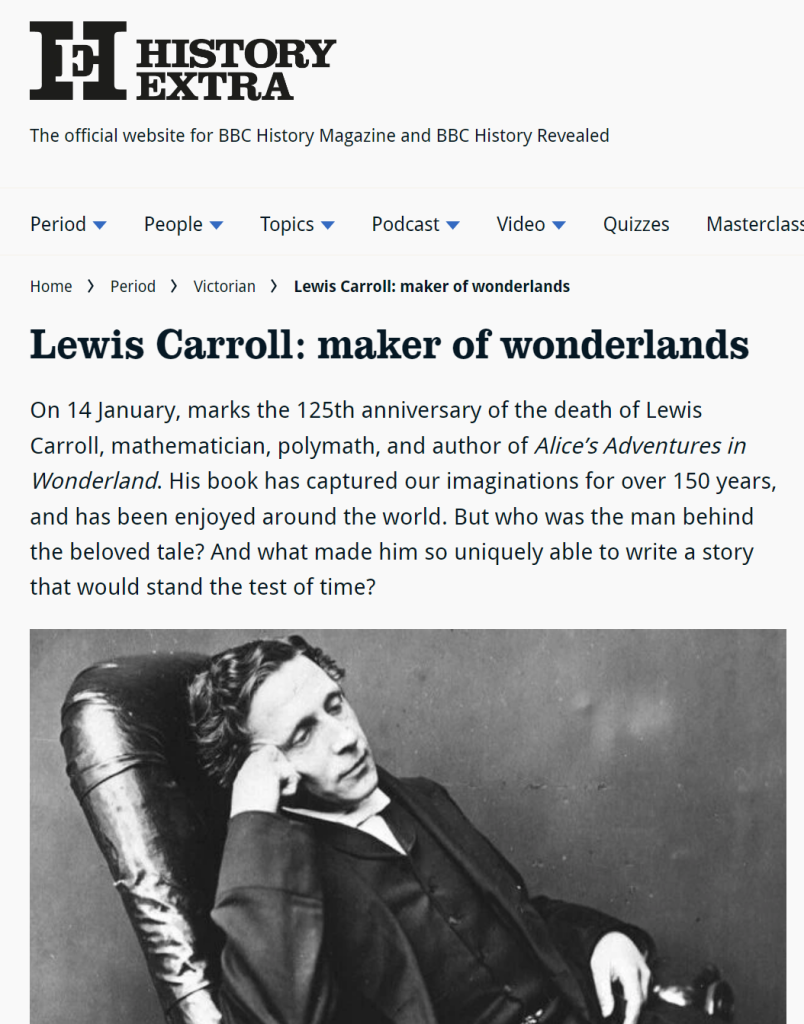
To honour the 125th anniversary of Lewis Carroll’s death, BBC History asked me to write an article about the man, his life – and of course his most famous work: Alice’s Adventures in Wonderland.
It’s unusual to have 2000+ words to explore a topic in a little more depth – so I hope you enjoy this portrait of the “maker of Wonderland” which is out today.
As for one of my favourite parts of the story, though, scroll on…
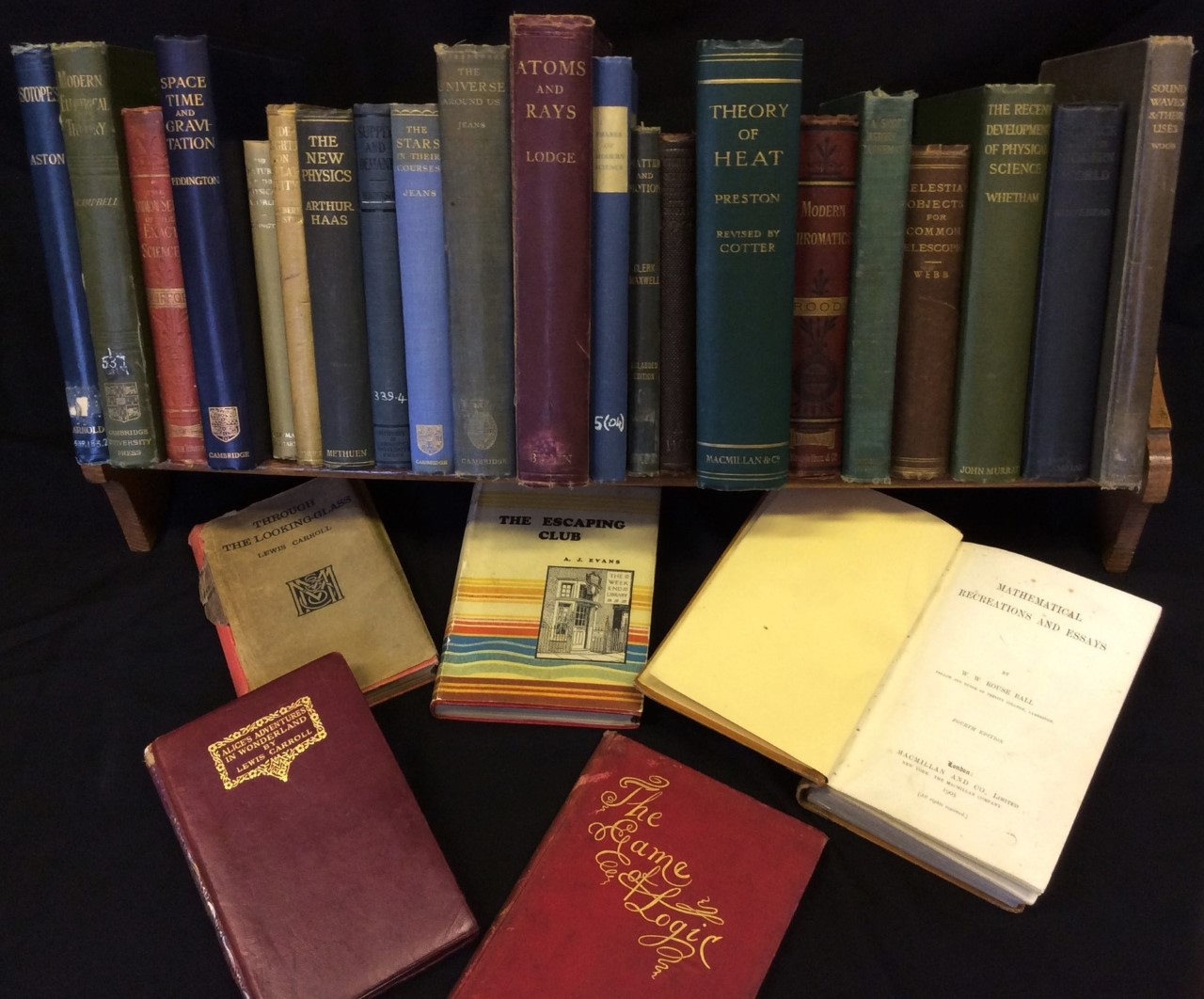
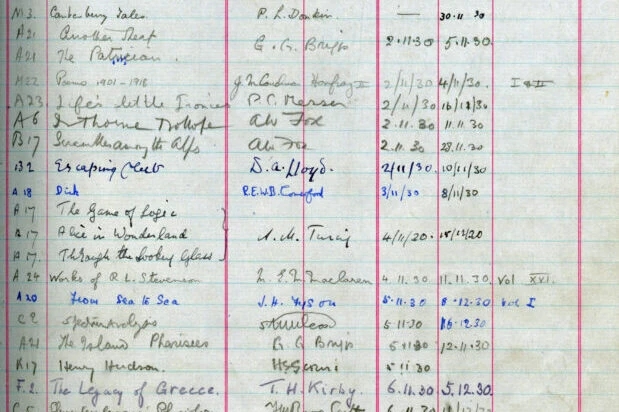
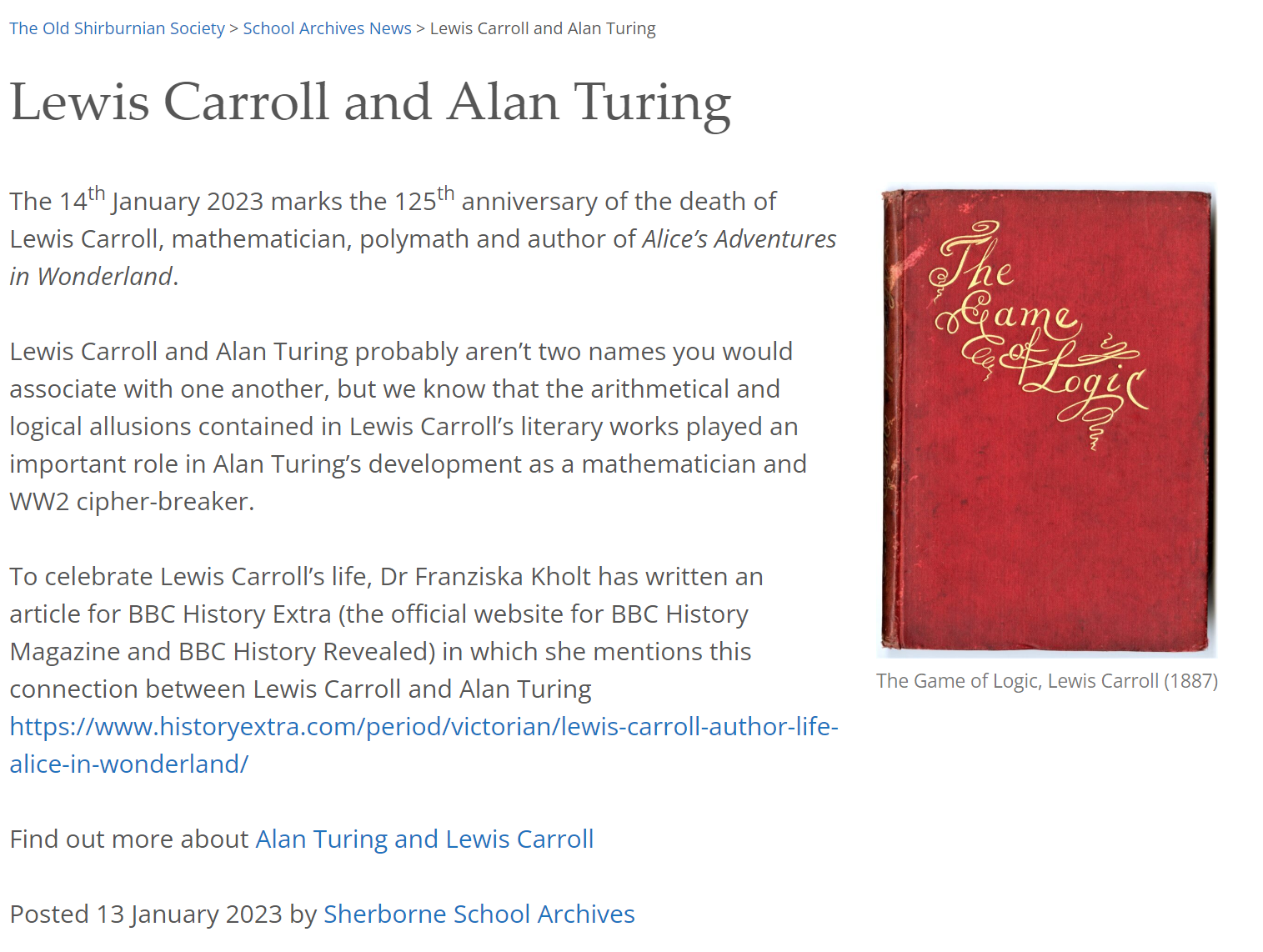
One of my favourite parts of this story comes right at the end. Among the people who admired Carroll and was inspired by his work – his mathematics as well as his fiction, was the young Alan Turing, who borrowed from his school library at Sherborne both Alice books – Wonderland and Through the Looking-Glass – and The Game of Logic (pictures are courtesy of Sherborne School archives).
Sherborne School also feature the anniversary, as well as the Turing connection in a post on their website, as well as in their letter to current students and alumni.
Haven’t had enough of Halloween, and fancy figuring out the science behind table rapping?
The Royal Institution, some brave volunteers, some fab academics and myself explore the neuroscience, medical history and social context of seances in Victorian Britain, and why involuntary muscle-action was a big deal!
Did it work though? And are all volunteers now possessed? Click the video and find out!
Magic!
Table rapping! Seances!
Do they work?
Only one way to find out, thought @Ri_Science, and recreated the seance-staple of table rapping as an experiment, and invited me along to give some #histsci context!




 Dr Franziska Kohlt