
And… go! The Natural History Museum in Oxford has reopened!


In just over twelve hours’ time we’re back. Join us from 7am for breakfast, bugs, bands and an enormous sense of relief.
Photo: Rob Gregg
And… go! The Natural History Museum in Oxford has reopened!
In just over twelve hours’ time we’re back. Join us from 7am for breakfast, bugs, bands and an enormous sense of relief.
Photo: Rob Gregg
Filed under Uncategorized
Oh no! Happy hunting!

I bring you breaking news from the Museum of Natural History. As you all know, the Museum has been closed for over a year and, during that time, a number of our specimens have been popping up in unlikely places around Oxford city centre.
The Goes to Town project has seen a penguin in the fish mongers, a bank vole in the bank and a book worm in a book shop. All was going swimmingly until today.
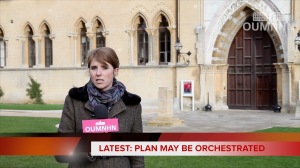 We’ve been receiving reports from several of our Goes to Town venues that there’s been a breakout. The snowy owl has vanished from the University Church, the edible insects have escaped from the Turl St Kitchen and a white rabbit is on the loose from the Central Library. There’s trouble afoot.
We’ve put together a special bulletin of Oxford University Museum of Natural History News.
Reporters Bethany Palumbo, Jess Suess and Scott Billings…
View original post 134 more words
Filed under Uncategorized
Saturday 1 March 2014, 11am–5.30 pm
This one-day symposium at Wolfson College, Cambridge will consider Dickens’s letter writing in the context of his life and novels, with papers from leading Dickensian scholars including Michael Slater, Jenny Hartley and Paul Schlicke. Presented and hosted by the Dickens Fellowship, with generous support from Wolfson College, the symposium will pay tribute to Margaret Brown and her lifetime work editing Dickens’s letters.
Speakers
ANGUS EASSON: ‘“A Dickens Letter! – Is It or Ain’t It?”: Some Forgeries and Some Questions’
JENNY HARTLEY: ‘Letters in Dickens’s Novels’
LEON LITVACK: ‘Dickens’s Irish Friends and Family Ties in the Letters’
PAUL SCHLICKE: ‘Reading between the Lines: Dickens and his Second-Best Scottish Friend’
MICHAEL SLATER: ‘Dangerous Quarrying: Dickens’s Letters and the Biographer’
Fee: £21.00 (includes a sandwich lunch, morning and afternoon tea and coffee, and a wine reception)
Contact: Dr Christine Corton, Wolfson College, Cambridge CB3 9BB (clc67@cam.ac.uk
View original post 7 more words
Filed under Uncategorized
Consider signing up for this great event! It’s free!
Free symposium: Damaging the Body
Thursday 17th October 2013, 6-9 pm
Damaging the Body
Body and Mind: Mesmerism in Nineteenth Century Culture and Literature
Barts Pathology Museum
This symposium will seek to explore the relationship between the sciences and Victorian mesmerism, psychical research and parapsychology.
This event has been kindly sponsored by the British Society for Literature and Science.
Speakers:
Prof. William Hughes (Bath Spa University) ‘The Theatre of His Beastly Exhibitions’: The Erotic Nature of Early Victorian Magnetism’
Andreas Sommer (UCL Centre for the History of Psychological Disciplines) ‘Mesmerism, hypnotism and the formation of modern psychology in Germany’
This event is free but tickets will need to be booked in advance.
Book online here.
The event will take place at St Bartholomew’s Hospital, Pathology Museum and Gallery, 3rd Floor, Robin Brook Centre, West Smithfield, London, EC1A 7BE
Nearest tube: St Paul’s
Doors open at 6pm, when there…
View original post 29 more words
Filed under Uncategorized
These belong to my favourite illustrations of the Divine Comedy – do take a look!
Filed under Uncategorized
Another interesting Call for Papers!
IBBY UK/NCRCL MA CONFERENCE, 9 NOVEMBER 2013
University of Roehampton, London.
Call for Papers on the theme of ‘Feast orFamine: Food and Children’s Literature’
As a focus for imaginative gratification, food has a long-standing relationship with children’s literature. Sinclair’s jam-filled ‘coach-wheel’ in The Holiday House (1839) revolutionised Evangelist writing, as culinary reward overshadows recrimination; marmalade sandwiches and honeypots are as iconic as the Paddington and Pooh bears who favour them; and the delights of feasting reach from the comic visualization of The Beano to the excessive wizardry of Hogwarts banqueting. Darker shadows also trouble this relationship though; Brenda’s philanthropy in Froggy’s Little Brother (1875) witnesses the starvation of mice and children, while Andy Mulligan’s Trash (2010) condemns capitalist greed. Moving beyond the immediate concerns of children’s literature, the rise of cup-cake culture in the early 21st century and the recent success of the BBC’s TheGreat British Bake…
View original post 289 more words
Filed under Uncategorized
Anyone for this? Looks amazing!
CFP – Lesser Victorians: Beyond the Canon in Victorian Fiction
Trinity College Dublin, Ireland – 12-13 September 2013
Deadline for proposals: 31 May 2013
“sun destroys/ The interest of what’s happening in the shade” (Philip Larkin)
Scholarly research into the iconic fictions of canonical Victorian writers like Dickens, Thackeray, Eliot and Hardy continues to grow and ramify in rich and often unexpected ways. Thanks however to unprecedented and ever-expanding digital access to works long out of print, as well as ongoing excavations by scholars such as John Sutherland, the issue of non-canonical, ‘minor’ and outright forgotten fictions is now on the agenda of Victorian studies as never before.
This two-day conference will be dedicated very particularly to just such marginalised fictions and their writers. We invite proposals for 20-minute papers whose focus might include but would not be restricted to:
· close readings of individual texts;
· critical appreciations of…
View original post 180 more words
Filed under Uncategorized
I will be presenting a paper on the influence of Victorian science, pseudo-science and literature on the works of Ivan Turgenev ad Fyodor Dostoevsky at this conference – have a look!
Filed under Uncategorized
Wonderful blog-post about the charming Romanian illustrations of Alice’s Adventures in Wonderland
Filed under Uncategorized
This is a line by graveyard poet Thomas Gray (a friend of Horace Walpole, in whose former villa I coincidentally work) – it was also more recently tweeted by the Folio Society. The Folio Society preserves literary classics, by republishing them as beautiful and authentic bound editions – full of “thoughts that breathe and words that burn” and have done so over years, decades, centuries. Few of those editions contain poetry. Why? Good question. And to be honest, I don’t think there’s a definite answer to this question.
We always speak/ hear/ read about “literary classics” – and of course, everybody could come up with a fair number of them, off the top of their heads. But what about poetry – what about lyrical “classics”? For me, poetry has always been deeply personal (yes, of course, my taste in novels, too, is personal, but in a different way – let me explain). There are those poems I read with my grandma as a child, and still know by heart – Goethe’s “Gingko Bilboa”, Annette von Droste-Hülsoff’s “Brennende Liebe” (which I adored for the simple reason, that it had a Cello player in it – Cellos are cool) – I remember them for their emotional value. There are the spooky ones, I got to like as a teenager (and yes, I still like them), such as E.A. Poe’s “The Raven” or Heinrich Heine’s “Belshazzar” – I remember them because they are cool, and always good to creep people out, spontaneously. There are the funny ones, Edward Lear’s and other Limericks are just fantastic – I remember them because they’re funny and just stick with you. And, of course, there are also the ones we had to learn in school – “classics” – if you like. Wordsworth’s “Daffodils”, or rather “I wandered lonely as a cloud…”, Shakespeare’s “Shall I compare thee…” sonnet, Goethe’s “Erlkönig” or Heine’s “Schlesische Weber”. I remember them, because I had to (once).
I agree with Gray (whose “Elegy written in a Country Churchyard” I should probably know by heart, but don’t) – but in reverse order. Poetry is “words that burn” – into your memory – and when they do precisely that, to a large number of people – they become classics. But what makes them special, and important to us, is, when those “words that burn” turn into “thoughts that breathe” – which gives us a fifth category of poems, probably akin to the first one, I explained above: the ones you love, the personal ones, that breathe within us. Love at first sight. You love them, you maybe don’t even know why, but they stir something within you. And for me, the ultimate love at first sight-poet was Dylan Thomas – not necessarily the poet himself, his looks or his biography (which is equally fascinating, though) – but really, mainly his poetry.
In 2009, I visited the Dylan Thomas Centre in Swansea/Abertawe, his hometown, oblivious of the man and his poetry. I was an exchange student in Wales, I studied Literature, Swansea wasn’t exactly the most exciting place in the world, so I kind of escaped right into his arms. Part of the interactive exhibition was a digital collection of the poems read by the author himself, I clicked “Fern Hill” on the display, because it sounded cool and mysterious, and that’s when I fell in love, unexpectedly and out of the blue. The poet’s voice seemed to echo the meaning of the poem’s words – it swayed like the “apple-boughs” in the wind and lilted with the “lilting house”, and almost sang, like the youth who was “prince of the apple towns”, it was likewise “carefree” and “light”, sometimes fading, but then still brilliantly “flashing in the dark”. — And the lines remained with me, especially the final two, which cryptically also adorn the poet’s memorial stone at Poet’s Corner, Westminster Abbey: “Time held me green and dying, while I sang in my chains like the sea”. Words that burn, thoughts that breathe.
And that’s what poetry is about. Words that burn, and thoughts whose breath, in its insubstanciality, you cannot always grasp. So maybe it does really work Gray’s way round, as well: thoughts that breathe within you, continuously reinvigorate new ones, and new meanings; while words, that, in their staticness, burn, and will continue doing so, as long as you cherish them. I still know the words to “Gingko Bilboa”, and so does my now almost 90-year old grandmother.The poem ends with the line “Spürst du nicht an meinen Liedern, dass ich eins und doppelt bin?” (“Do you not feel in my songs, that I am one and yet of twofold nature?”) – the Gingko leaf becoming a metaphor for the twofold human nature, but also, the twofold nature of the poem itself, since it is those words, on the one hand, but also, those ideas – your thoughts, that give the poem life and meaning. And that’s why actually, you make a poem a classic, your classic, your personal favourite: you’re becoming its new home, preserving it, in a super-personal special edition, that’s yourself.
So dig out that poem you liked in school, as a teenager, the one your mum read to you, that nursery rhyme you can barely remember – and celebrate World Poetry Day by reading it again (and maybe share it – I love to getting to know new poems – hint, hint) – Happy World Poetry Day!
Links:
Dylan Thomas reading “Fern Hill”
Johann Wolfgang von Goethe’s Gingko Bilboa (in multiple languages)
Filed under Uncategorized
 | Karyn on George MacDonald’s Scotl… |
 | Deborah on George MacDonald’s Scotl… |
 | frankendodo on George MacDonald’s Scotl… |
| Ruth Ballott on George MacDonald’s Scotl… |


 Dr Franziska Kohlt