
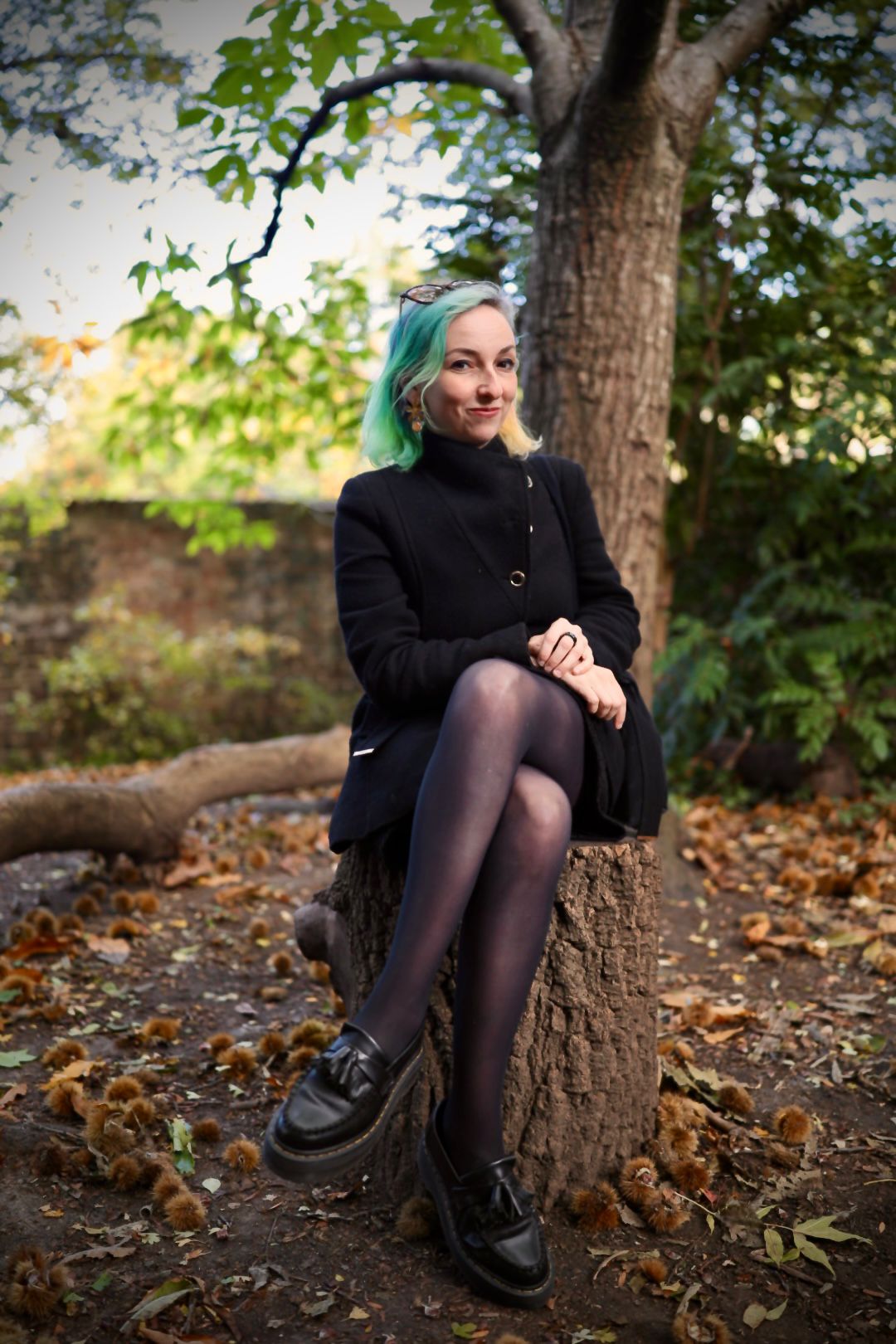
I am an academic, curator, broadcaster and public speaker. As a Historian and Sociologist of Science, a scholar of Communication, Narrative and Comparative Literature, I’m interested in the role that metaphor and narrative framing shape our understanding of science and technology. I am also an expert on the works of Lewis Carroll, author of Alice’s Adventures in Wonderland.
I am currently a Leverhulme Research Fellow at the University of Leeds and recent Inaugural Carrollian Fellow at the University of Southern California, Los Angeles.
My expertise covers intersections of
- History of psychology, its links with the cultural histories of automata and Artificial Intelligence,
- Entomology and public perception of insects, and the ideologies of metaphorical use of insects
- History of Childhood, Education and educational literature & media
- Rhetoric in Medical and Environmental Communication, especially the effect of religious and conflict metaphors
- The history of constructing the figure of the Scientist, and other entanglements of science, the public and the role of storytelling
Bio:
(TL;DR)
I completed my doctoral thesis at the University of Oxford which examined the co-emergence of the science of Psychology, and the genre of fantastic literature, and their shared use of narrative and metaphor to digest and communicate new scientific knowledge, and their societal and epistemological implications. I then joined the University of York’s Department of Sociology & Centre for Science and Technology Studies, researching the impact of metaphor during the Covid-19 epidemic on public understandings and behaviours (read more here and here).
My academic, curatorial and broadcasting work enrich one another. As the Inaugural Carrollian Fellow at University of Southern California, a generous Visions and Voices grant recently enabled me to convene academics, Disney entertainment professionals, and professional magicians to explore in my project “Spectral Science“, the shared histories of Science, Technology, Entertainment and Deception, from Magic Lanterns, to alien hoaxes, and AI Deep Fakes. Our exhibition, loaning for the first time items from Hollywood’s legendary Magic Castle, and an especially commissioned, authentic Phantasmagoria magic lantern invited public audiences to find orientation within disconcerting present problems through exploring their surprising rich and complex histories.
Such interdisciplinary cross-sector practice, have informed my teaching at universities in the US, UK and Germany, and several Oxford Colleges, in Sociology, History of Science, and English & Comparative Literature, in fields as diverse as Science Communication, History of Environment, Mind, and Childhood, and 19th, 20th & 21st ct century, Literature, Science and Religion, Children’s and Fantastic Literature, Science Fiction and Visual Culture.
I have worked with industry leaders, professional bodies, national and international media, as well as with museums and schools. I was the first PhD student ever to appear on BBC “In Our Time” (twice!). I have been involved in a broad variety of school outreach projects, from media literacy, AI, climate change, to journalism, and English Literature. As Keynote Speaker for Capgemeni I have reflected with industry leaders on ethical AI at conferences in Bussum and Amsterdam, and together with the Royal Entomological Society I have championed the significance of storytelling as a priority in combating biodiversity loss. I advised the Church of England and Catholic Climate Action Group Laudato Si’ in Science Communication, during the Covid-19 pandemic.
If you’re interested in working with me as consultant, curator, or speaker – I would be excited to find out how we can work together. (And just in case you’re anxious, it’s pronounced [fʁan.ˈʦɪs.ka: koːlt] – or, Fran!)
My research:
(the long read)
Sociology of Science:

My work on Narrative and Science spans both history and present, health, environment and technology – and the role and effect of narrative in relation to them – especially the impact of religious narrative tropes. I have, for instance, monitored narratives of the Covid-19 pandemic in the UK, and analysed specifically how the UK’s use of warfare language relied on a distinct cultural framework in which these acted as religion (see also here). I also studied the complications of hagiographic practices and narrative patterns in science communication and historiography of science, framing within historic precedent current practices of ‘promoting science, scientists, and risks of scientism, as well as complications on the intersections between science and populism.
English & Comparative Literature:
As my postdoctoral work focused on metaphors, narratives and analogies in science communication of the present day, my doctoral work, which explored the emergence of Victorian psychology and fantastic literature as sister phenomena, can be understood as groundwork for this. I considered the work of the author-scientists George MacDonald, Lewis Carroll, Charles Kingsley and H.G. Wells and their literary portrayal of visions experienced in dream, illness and near death within the wider framework of the Victorian history of science, and establish within it fantastic literature as a primary medium for ‘making visible’ epistemological debates of the nature of consciousness, and the nature of the soul, early ideas of the subconscious and dream theory to evolutionary psychology. As these works, and their authors, actively participated in developing, anchoring, contesting and transforming the language, imagery and narratives of the psychological science in their time, my thesis robustly challenged the perception of Fantasy as an escapist genre, by elucidating it as a problem-solving genre, that promoted types of problem-solving thought marginalised in intellectual discourse at the time.
Lewis Carroll, Children’s Literature, and History of Science:
I am a leading, interdisciplinary researcher in Lewis Carroll studies. My work has been called ‘field-changing’, and the best that ‘cross-disciplinary scholarship can offer’, and has recently been nominated for the Children’s Literature Society’s book prize. I have a long-standing interest in the life and works of Lewis Carroll, especially in reconstructing his scientific and polymathic biography. I have authored articles on how Lewis Carroll’s preoccupation with entomology, and involvement in the shifting professional field of Victorian psychiatry were reflected in his writings.
This interest sits within my wider specialism on the role of children’s literature and its forms in science communication and education. Science literature for children has a sustainable influence on our understanding of science, and have historically constituted a crucial component in endeavours in public science education. My research is interested in the subjects, and forms were deemed valuable and appropriate for children, and what insights the resulting languages and narratives allow into the motivations and ideological dimensions and cultures of science, in past and present.
Summary:
More specifically, my work covers the following areas and their intersections:
- Storytelling & Narratives in Science (metaphor & analogy), impact on knowledge & belief-formation, and behaviour change (history & present)
- Children’s Literature and Culture, especially science & education
- Fantastic Literature, its tropes and structures, Science Fiction
- Dreams and Visions, Spectres and Hallucinations
- The History of Science, Medicine, Psychology and Psychiatry
- Narratives of Illness (Death and Dying, History of Suicide)
- Ecocriticism, Environmental History, Cli-Fi, Ecology in Art & Design
- The History of Technology, Automata, Automation, AI and Society
- Science & Religion (History & Present)
I have written on the work of the following authors, personalities and institutions (amongst others):
- Lewis Carroll, H. G. Wells, George MacDonald, Charles Kingsley
- Robert Wilfred Skeffington Lutwidge, Hugh Welch Diamond
- William Morris, William de Morgan, John Ruskin, Octavia Hill
- Gilbert & Sullivan, John Tenniel, Linley Sambourne
- E.T.A Hoffmann, Novalis, J.W. von Goethe and Erich Kästner
- The Society for the Diffusion of Useful Knowledge, The Lunacy Commission
Impact & Knowledge Exchange:
My research interests are versatile, and interested in public perceptions of science and science communication, and have received wide media attention. My work on narrative tropes of the Covid-19 pandemic, especially warfare narratives, which examined the ethics of such rhetoric in the setting of pandemics and drew comparisons to the rhetoric of the Victorian cholera crisis in Britain, especially that employed by Christian ministers has featured in numerous outlets, from training workshops for the Church of England and Thought for the Day, to the Guardian. I am an expert on Lewis Carroll, and have published articles on various aspects of the work of Lewis Carroll, including ‘The stupidest Tea-Party in all my life: Lewis Carroll and Victorian Psychiatry’, the first in-depth exploration of the origin of Lewis Carroll’s interest in the science and practice of insanity, and its portrayal in fiction. My article ‘From Scotland to Utopia (via Hammersmith): William Morris, George MacDonald and the Utopian ecological aesthetic’ multifaceted Victorian preoccupations with ecology has appeared in the Journal for Scottish Thought.
I written shorter pieces on the broader interactions of literature, science and culture: a blog on the implications of what “Following the Science” really means, an article on Fairies and Dreaming appeared on Harvard University’s blog, another piece on Victorian Insect-mania was commissioned by the Royal Entomological Society and Alice in Cyberspace for The Conversation. An article on Dickens, Time-Travel and Near-Death-Experiences, entitled ‘Back to the Future: The Time Traveller’s Traumatic Jetlag in A Christmas Carol“, appeared in Dickens on the Move – Between Cultures and Continents.
My work has appeared on including BBC4’s ‘In Our Time’, BBC World Service’s ‘The Forum’, CBC Radio’s ‘Ideas’, ARTE documentaries, including Invitation au Voyage/Stadt Land Kunst or TRT’s Showcase, the Birmingham Literature Festival, Bristol Technology Festival and COP26. Several of my shorter pieces and journalistic features have appeared in Newspapers such as the Oxford Mail, The Conversation, and Liasons – Magazin für den Kulturaustausch.
I have also acted as curator and consultant for award-winning exhibitions including ‘Insects through the Looking-Glass (Story Museum & Royal Entomological Society, 2018) and most recently the critically acclaimed Marvellous Mechanical Museum exhibition at Compton Verney.
I am the editor of The Lewis Carroll Review and former Reviews Editor of the British Society for Literature and Science, and my own reviews have previously appeared, among others, in the Lewis Carroll Review and the Journal of Literature and Science.
I frequently give public talks and interviews (see papers & talks section), and am involved in several public engagement projects, such as Oxford’s Alice’s Day. I have in the past worked as a translator for Marvel Comics. As a mezzo-soprano I have been a member of classical choirs and the Gilbert & Sullivan Society of the University of Oxford. I also practice historical fencing, and enjoy photography, gardening and the theatre.
If you find my work interesting and would like to contact me, invite me as a speaker, or follow even more of my online-ramblings, you can find me on Instagram, Bluesky departmental page of my institution, or feel free to send me a message on LinkedIn or simply send me an email [franziska(at)kohlt.com].


 Dr Franziska Kohlt
Hello Sue!
I’ve seen, that you are interested in psychedelic/death-spheres… In case of that (not sure wether this phrase is correct) I recommend a very strange, but stunning movie to you: http://en.wikipedia.org/wiki/Enter_the_Void ….. An astonishing piece of non-mainstream movie-culture. Have fun and keep yourself candid!
Sounds great! I shall look into it!
i want to read it ..
Upward and yet not Northward: Journeys through Dream, Death and the Fourth Dimension in H.G. Wells’s Short Fiction.please please please
Krass, ich warte noch auf den Wikipedia-Eintrag.. 😀
Hi there, saw a lone ‘like’ on the Cambridge Children’s lit FB page from you re my Peter & Wendy essay in the Journal of Analytical Psychology – and found my way to this page! Have recently written something for the International Journal of Psychoanalysis – currently under review – on Pinocchio too. I’m mulling a PhD at Cambridge on something Children’s Lit/Psychoanalysis related – any advice you could offer? Best, Adrian
Thanks for your comment! Maybe our paths will cross at the big Alice conference at Homerton in September? Let’s certainly have a chat – I’ll send you a message! All best, Fran
Sadly I’ll be working most of the Alice week, but might be able to some of the events either in London or Oxford for the last couple of days. Feel free to add me on FB for a chat – your interests in psychology/neurology and children’s lit might have some cross overs with some of the things I’m interested in – more psychoanalysis looking in on children’s lit… 🙂
…might be able to *get to* some of the events… (sic)
Written pre morning coffee!
Hi Fran, I sent a reply to your email and a copy of my Pinocchio piece. Did that get through? Best, Adrian